


Clearing out a longtime home before selling takes longer than most people expect — but it's far more manageable with the right system. For downsizers and families in the Willamette Valley, a realistic clearout takes several months at minimum, and starting with a room-by-room plan makes all the difference.
Most of the advice about selling a home focuses on pricing, timing, and what to fix before you list. Very little of it addresses the part that actually stops people in their tracks: standing in a home full of decades of living, looking around at furniture, collections, closets, and cabinets, and not knowing where to begin.
This guide is for that moment. Whether you're a homeowner preparing to downsize or a family member helping with the process, what follows is a practical framework — a working system you can actually use, not just a list of things to feel good about later.
Why the Clearout Is the Step That Makes or Breaks Your Timeline
A home that's ready to photograph and show is a home that's been cleared, edited, and presented with intention. Buyers notice clutter — and more importantly, so do cameras. A home that looks full and personal in listing photos generates fewer showings, and fewer showings mean longer days on market.
In today's Willamette Valley market, where homes are sitting longer than they did even two years ago, presentation carries more weight than it once did. The clearout isn't just an emotional exercise — it's a direct factor in how quickly your home sells and at what price.
The families who do this well almost always started earlier than they thought they needed to.
Before You Touch Anything: The Two Decisions That Come First
Before a single box gets packed, two things need to be established.
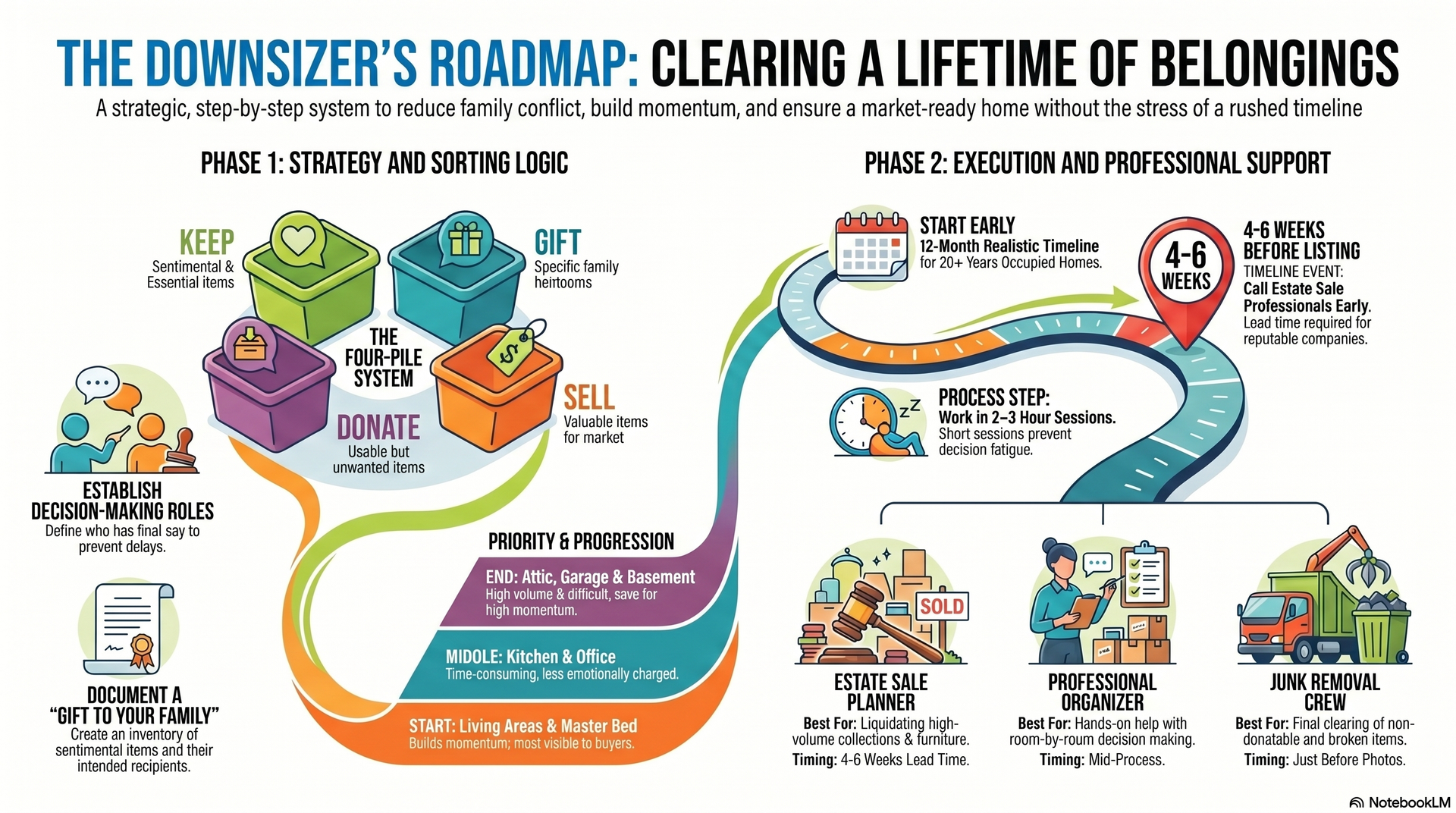
The first is clarity on who's making decisions. In a downsizing situation, this is often a shared process between the homeowner and one or more family members — and without a clear understanding of who has final say on what, the sorting process can stall over every disputed item. A brief conversation up front about roles saves a great deal of friction later.
The second is a walkthrough with your agent. Before the physical work begins, it helps to know what the home needs in order to list — what can stay for staging purposes, what needs to go, and whether any repairs or updates are part of the plan. That context shapes how you sort, and it keeps you from clearing out items the home actually needs to show well. If a parent is part of this transition, our guide to helping a parent sell without rushing the process covers the family dynamics and pacing considerations in more detail.
A Gift to Your Family: The Inventory List
If the homeowner is still actively involved in the process, one of the most valuable things they can do — right now, before the sorting begins — is walk through their home with a notebook, a spreadsheet, or even a voice recording app and document which items carry family meaning and who they'd want to have them.
It doesn't need to be formal. A simple list that says "the oak sideboard goes to Michael, the blue china set goes to Sara, and the desk in the study belonged to Dad's father" can prevent weeks of family deliberation later. It removes guesswork, reduces conflict over sentimental pieces, and makes the four-pile process significantly faster and less emotionally loaded for whoever is doing the sorting.
This kind of documentation is most useful when it happens before health or cognitive changes make it more difficult. Think of it less as an administrative task and more as a gift to the people you love — a clear record of what mattered and where it should go.
The Room-by-Room Order (and Why It Matters)
When it comes to clearout sequence, there are two kinds of difficult — emotionally difficult and logistically difficult. The instinct is often to avoid both. But they call for different strategies, and understanding that distinction makes the whole process more manageable.
Emotionally difficult rooms are worth tackling early, because they're also the ones buyers see first. Logistically overwhelming spaces — the ones with sheer volume and years of accumulated layers — are better saved for when you've built some momentum and decision-making rhythm.
A workable three-phase order for most homes:
Start — Living Areas and Master Bedroom. These carry the most emotional weight, and they're also the most visible to buyers. Getting them cleared and staged-ready early gives you a reference point for how the rest of the home should feel — and completing them first builds the kind of momentum that carries you through the harder logistical work ahead.
Middle — Kitchen, Office, and Secondary Bedrooms. Time-consuming and practical, but less emotionally charged than the main living areas. These spaces tend to accumulate a mix of duplicate items, forgotten keepsakes, and things that simply haven't been used in years. Manageable once you've found your rhythm.
End — Attic, Garage, and Basement. The highest volume and the easiest to avoid — which is exactly why they belong at the end, when momentum is built, decisions are coming more naturally, and the finish line is in sight.
Work in sessions of two to three hours rather than full days. Fatigue leads to poor decisions and stalled progress.
The Four-Pile System: Keep, Gift, Donate, Sell
For every room, every drawer, and every closet, every item gets sorted into one of four destinations: keep, gift to a specific person, donate, or sell.
The inventory list you created earlier handles most of the gifting decisions in advance. For everything else, a few practical rules help:
- If you haven't used it in two years and it holds no sentimental value, it donates or sells.
- If two family members want the same item and there's no documented preference from the homeowner, the default should be a conversation — not a standoff.
- If an item has sentimental meaning but no practical home in the new space, gifting it to someone who'll use it is often more satisfying than storing it indefinitely.
Keep the four piles physically separate as you work. Boxes that get mixed together slow everything down.
What to Do With the Big Stuff — Furniture, Appliances, and Collections
Large items need their own plan, and the earlier that plan is made, the better.
Estate sales are well-suited to homes with significant contents — furniture, collections, kitchenware, tools, and décor that has real resale value. The important detail most families miss: a reputable estate sale company needs four to six weeks of lead time at minimum. Calling them the week before you want to list is too late. If an estate sale is part of your plan, it's one of the first calls to make.
Consignment shops work well for individual pieces of furniture or art with genuine value. They're slower than an estate sale but can yield better returns on specific items.
Facebook Marketplace and local buy-sell groups move mid-range furniture and household items reasonably well, particularly in the Canby, Oregon City, and Wilsonville areas. It takes time to manage, but it's a practical option for items that are too good to donate but not worth an estate sale.
Donation pickups — through organizations like Habitat for Humanity's ReStore or local nonprofits — handle furniture and large items efficiently. Many offer free scheduled pickup, which removes the logistics burden significantly.
Junk removal crews are the right call for items that don't fit any of the other categories — broken furniture, outdated appliances, and the accumulated contents of a garage or storage space that has genuinely run its course.
When to Bring in Professional Help — and Who Does What
Three types of professionals handle different parts of this process, and knowing which one to call first makes a meaningful difference.
Estate sale planners manage the liquidation of a home's contents — pricing, advertising, and running the sale itself. They specialize in moving volume and getting fair value for a wide range of items. Because they need four to six weeks of lead time, they should be contacted early — well before the listing conversation begins.
Professional organizers are a strong resource for clients who need help making decisions room by room but aren't at the point of a full estate sale. They provide structure and momentum, and they work alongside the family rather than taking over the process.
Junk removal crews handle the end-of-process cleanup — the items that didn't sell, didn't donate, and need to go before the home can be photographed.
This is also where working with an agent who is genuinely embedded in the process from the beginning makes a practical difference. We help coordinate the right vendors at the right time, connect clients with professionals we know and trust, and make sure nothing falls through the gaps between the clearout and the listing. In the Canby and Willamette Valley area, contractors, movers, and estate sale planners are busy — families without existing relationships can wait weeks just to get a call back. That lead time matters when you're working toward a listing date, and it's one of the reasons we encourage sellers to reach out well before they feel ready.
How the Clearout Connects to Your Listing Timeline
The clearout doesn't happen in isolation — it runs in parallel with staging decisions, repairs, and photography scheduling. Understanding how it fits into the broader timeline helps you avoid the most common mistake, which is treating it as something to handle right before the real work starts.
A realistic picture: for a home where someone has lived for 20 years or more, starting the clearout process a full year before your target listing date is not excessive — it's often exactly right, particularly when a parent or family member is part of the decision-making and items need to be documented, distributed, and sorted thoughtfully rather than quickly.
For families working on a shorter runway, four to six months is a workable minimum if the process is focused and consistent. Factor in the estate sale lead time, any repairs, staging, and photography, and you're looking at a timeline where every piece depends on the one before it. Starting earlier creates options. Starting late creates pressure — and pressure is when mistakes happen.
We work with sellers from the earliest stages of this process, not just at listing time. The sooner we can walk through the home with you, the more options you have and the less stressful the path to market becomes.
Frequently Asked Questions
How long does it realistically take to clear out a house before selling?
For a home where someone has lived for 20 years or more, starting a full year before your target listing date is often the most realistic and least stressful approach — particularly when a parent or family member is involved in the sorting and decision-making. For sellers working on a tighter timeline, four to six focused months is a workable minimum. The homes that experience the most stress are almost always the ones where the clearout started too late.
Should we have an estate sale before or after the home is listed?
Before — and ideally well before. An estate sale held while the home is on the market creates scheduling conflicts with showings, leaves the home in a less-than-ideal state for buyers walking through, and compresses the timeline unnecessarily. Plan the estate sale first, allow time for the home to be cleared and prepared, and then list. Estate sale companies typically need four to six weeks of lead time, so that call should happen early in the process.
What do we do with items nobody in the family wants?
This is more common than most families expect, and it's nothing to feel guilty about. Donation pickups through organizations like Habitat for Humanity's ReStore handle a wide range of furniture and household items. Local nonprofits, Buy Nothing groups, and community donation centers are also good options. For what remains, a junk removal crew is a practical, efficient solution — not a last resort, just the right tool for the job.
We work with downsizers and their families across the Willamette Valley — from Canby and Oregon City to Salem, Keizer, Woodburn, Hubbard, and surrounding areas. We bring local market knowledge, a trusted vendor network, and firsthand experience with transitions that carry real emotional and logistical weight.
Reach out for a local snapshot — no pressure, just real insights.
Ruth & Frank Howard, Brokers | Equity Oregon Real Estate
 All information provided is deemed reliable but is not guaranteed and should be independently verified. IDX information is provided exclusively for consumers' personal, non-commercial use, that it may not be used for any purpose other than to identify prospective properties consumers may be interested in purchasing, and that the data is deemed reliable but is not guaranteed accurate by RMLSTM.
The content relating to real estate for sale on this web site comes in part from the IDX program of the RMLSTM of Portland, Oregon. Real estate listings held by brokerage firms other than Equity Oregon Real Estate are marked with the RMLSTM logo, and detailed information about these properties includes the names of the listing brokers. Listing content is copyright © 2026 RMLSTM, Portland, Oregon.
This content last updated on September 21, 2026 1:28 PM UTC at 4 AM. Some properties which appear for sale on this web site may subsequently have sold or may no longer be available.
All information provided is deemed reliable but is not guaranteed and should be independently verified. IDX information is provided exclusively for consumers' personal, non-commercial use, that it may not be used for any purpose other than to identify prospective properties consumers may be interested in purchasing, and that the data is deemed reliable but is not guaranteed accurate by RMLSTM.
The content relating to real estate for sale on this web site comes in part from the IDX program of the RMLSTM of Portland, Oregon. Real estate listings held by brokerage firms other than Equity Oregon Real Estate are marked with the RMLSTM logo, and detailed information about these properties includes the names of the listing brokers. Listing content is copyright © 2026 RMLSTM, Portland, Oregon.
This content last updated on September 21, 2026 1:28 PM UTC at 4 AM. Some properties which appear for sale on this web site may subsequently have sold or may no longer be available.
