

Selling your home for the first time in the Willamette Valley — what should you expect?
The process can take three to six months from preparation to closing. Knowing what happens at each stage — pricing, disclosures, showings, offers, and the closing table — makes the difference between feeling prepared and feeling blindsided.
Most people who sell a home for the first time have owned it for a decade or more. Life changed — the kids grew up, the job moved, the space stopped fitting — and now they're standing in a home they know inside and out, about to navigate a process they've never been on this side of before.
Buying a home and selling one are not the same experience. When you bought, you were searching, comparing, and reacting. As a seller, you're preparing, pricing, and waiting — and the decisions you make before you ever hit the market have a much bigger impact on the outcome than most first-time sellers realize.
This guide walks you through what the selling process actually looks like in the Willamette Valley, from the moment you decide you're ready to the day you hand over the keys — a clear picture of what's ahead at every stage.
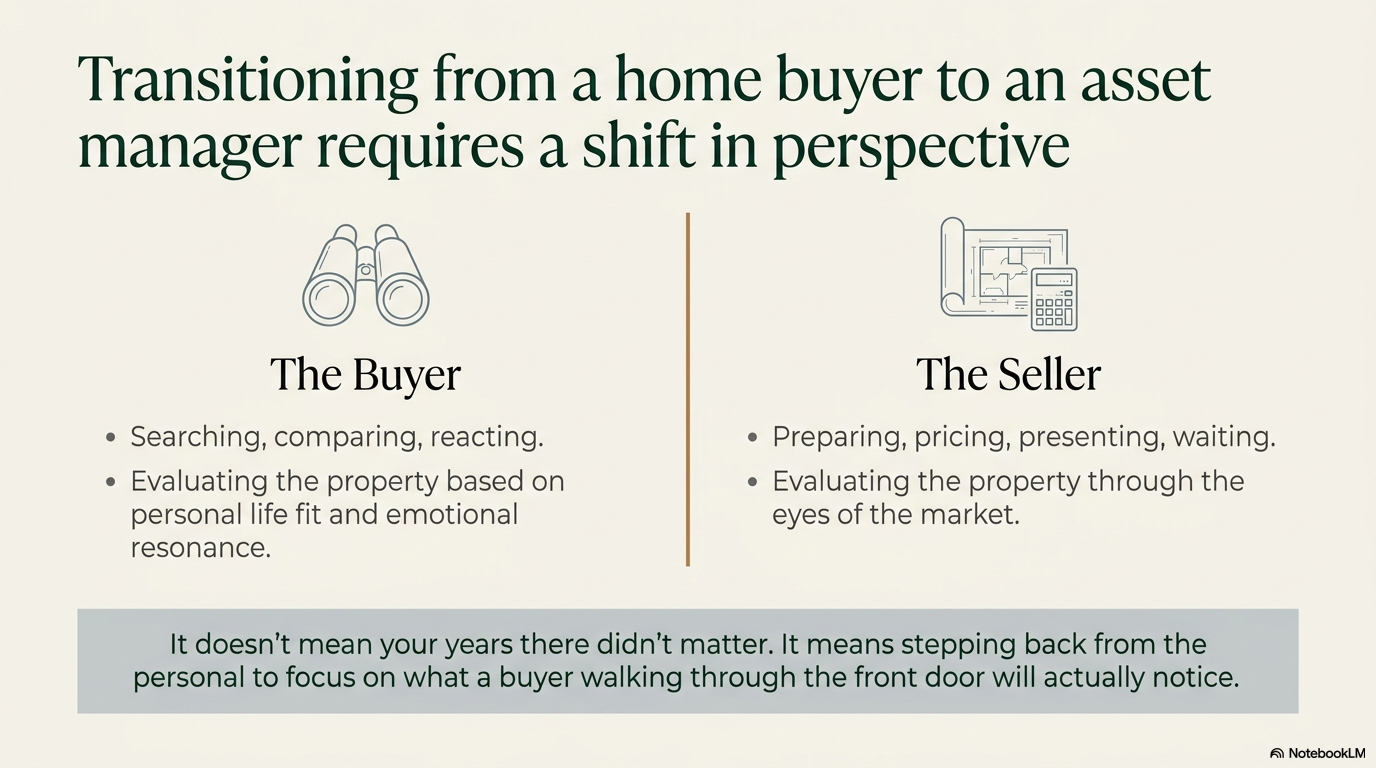
You've Been a Buyer. Being a Seller Is a Different Role.
When you bought your home, someone else had already done the work of preparing it, pricing it, and presenting it to the market. Now that role is yours.
The shift can feel disorienting at first, and part of what makes it work is learning to see your home through a different set of eyes. As a seller, you're no longer looking at your home the way you've lived in it — you're looking at it the way a buyer will see it for the first time. That shift in perspective is one of the most practical things you can do to prepare.
It doesn't mean your home isn't beautiful or that your years there didn't matter. It means stepping back from the personal and focusing on what a buyer walking through the front door is actually going to notice. A big part of that process is presentation — if you want to understand what that looks like in practice, our guide to what home staging really looks like for Willamette Valley sellers walks you through it room by room. The sellers who make that shift early tend to have a smoother, less stressful experience than those who hold on too tightly to how things have always been.
Radon testing is common here. The Willamette Valley has higher-than-average radon levels, and most buyers will test for it. If levels come back elevated, mitigation is available and the cost is manageable — it's a solvable problem, not a deal-breaker, and like most things in a real estate transaction, it's negotiable.
What Oregon Law Requires You to Disclose
Oregon sellers are required to complete a Seller's Property Disclosure Statement before accepting an offer. This is your document to fill out — your agent can answer questions about the process, but completing it is your responsibility as the seller. That's intentional. The disclosure reflects your firsthand knowledge of the home, and Oregon law is clear that it needs to come from you.
The form is comprehensive. It covers your roof, foundation, electrical and plumbing systems, water source, sewage system, title status, and any known defects or issues that could affect the property's value or safety.
The spirit of it is straightforward: if you know about it, disclose it. Trying to minimize or omit a known issue creates legal exposure after closing that far outweighs the short-term discomfort of being upfront. Most sellers find that completing the disclosure carefully and honestly actually helps — it sets realistic expectations going into the inspection period and positions you as a trustworthy seller, which matters to buyers.
If your home was built before 1978, federal law also requires a lead-based paint disclosure, and buyers must be given a window to conduct lead paint testing if they choose.
What Happens During the Inspection — and How to Handle It
After an offer is accepted, the buyer will typically hire a professional inspector to evaluate the home from top to bottom. For first-time sellers, this is often the most nerve-wracking part of the process — but it doesn't have to be.
A few things worth knowing about inspections in the Willamette Valley:
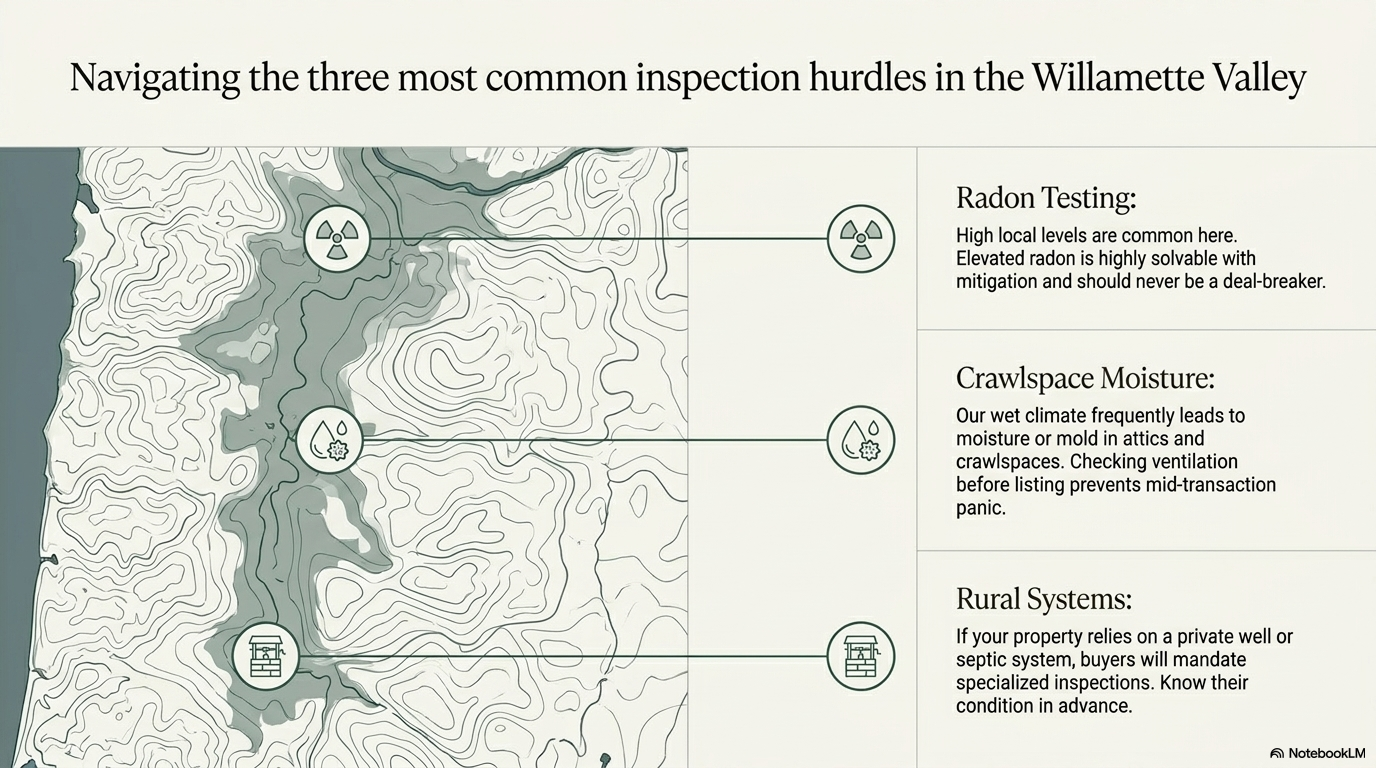
Radon testing is common here. According to the Oregon Health Authority, the Willamette Valley is one of the areas of greatest known concern for radon exposure in the state, and most buyers will test for it. If levels come back elevated, mitigation is available and the cost is manageable — it's a solvable problem, not a deal-breaker, and like most things in a real estate transaction, it's negotiable.
Moisture and mold in crawlspaces and attics are also frequent findings in our wet climate. Before listing, it's worth checking that your ventilation is working and that there are no obvious moisture issues. Addressing these things ahead of time prevents them from becoming surprises that rattle a buyer mid-transaction.
If your property has a private well or septic system, buyers will typically request those inspections as well. These are standard in the Willamette Valley for properties on private systems, and knowing the condition of both ahead of time puts you in a stronger position going into the inspection period.
When repair requests come in after an inspection, first-time sellers sometimes feel pressure to agree to everything or panic at a long list. Your agent's job is to help you evaluate which requests are reasonable, which are negotiable, and which you can push back on. Not every item on an inspection report requires a fix — and in many cases, a credit toward repairs is a cleaner solution than completing the work yourself before closing. Remember, once you're in contract, licensed contractors are generally required for agreed repairs. That's another reason a pre-listing walkthrough is worth doing.
One more thing worth saying directly: if you want top dollar for your home, doing as much as you reasonably can before you list almost always pays off. A buyer who walks in and sees a list of things that need attention doesn't think "I'll ask for a credit" — they wonder whether the home has been well cared for. That impression affects both the offers you receive and the price you're able to hold. Addressing issues ahead of time, while you have the flexibility to do it yourself and on your own timeline, is almost always the stronger move.
For more detail on what's worth addressing before you list — and what isn't — our post on what not to fix before selling your home covers this well.
Receiving Offers — What You're Actually Evaluating
When an offer comes in, the instinct is to look at the number. But the purchase price is only one piece of what you're evaluating.
A few things that matter alongside the offer price:
- Financing strength. A buyer with a solid pre-approval from a reputable lender is more likely to get to closing without complications than one with a weaker financial picture.
- Contingencies. Most offers include an inspection contingency and a financing contingency. Some buyers also include a sale contingency — meaning their offer depends on selling their current home first. Each contingency adds a layer of uncertainty.
- Closing timeline. Does the buyer's proposed closing date work with your plans? This is more negotiable than many sellers realize.
- Earnest money. A larger earnest money deposit can signal a more committed buyer.
The highest offer isn't always the best offer. Your agent will help you compare competing terms and think through which offer actually gives you the strongest path to closing — not just the biggest number on paper.
Closing in Oregon — How It Works Here
Oregon is an escrow state, not an attorney state. That means your closing is handled by a title and escrow company — not a real estate attorney — which is a different process than sellers in some other parts of the country may be used to.
The escrow company serves as the neutral third party. They hold the earnest money, coordinate the paperwork, manage the flow of funds, and record the deed transfer with the county. You'll review and sign final documents — either in person at the title company or, increasingly, through remote online notarization.
On closing day, or shortly after depending on when funding records, you'll receive your proceeds. The keys get handed over. The home officially belongs to someone else.
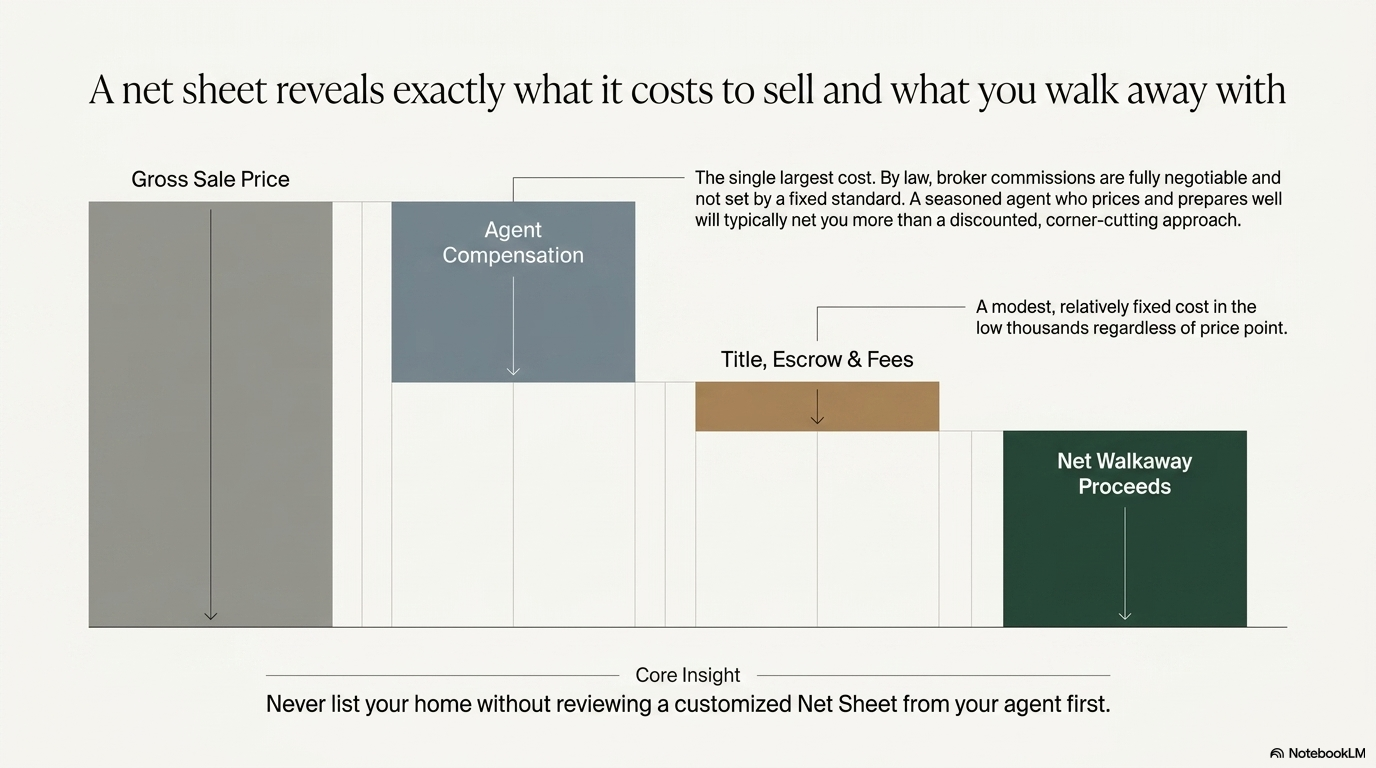
All costs — including agent compensation — are paid from your proceeds at closing. If you've run a net sheet ahead of time, nothing on the closing statement should surprise you. And if you haven't had that conversation yet, that's exactly what a first meeting with a seasoned agent is for. Compensation is always negotiable, and a good agent will be straightforward about what they offer and what it costs.
Frequently Asked Questions
How long does it take to sell a home in the Willamette Valley?
The full process — from preparation through closing — can take three to six months. A well-prepared, correctly priced home in the Willamette Valley typically goes under contract within two to four weeks of listing. Closing then takes another 30 to 45 days after an offer is accepted.
What are typical seller closing costs in Oregon?
On a conventional sale, seller closing costs include the owner's title insurance policy, escrow fees, lien search, reconveyance fee, and prorated property taxes. Title and escrow fees combined tend to be relatively modest. Agent compensation is the largest cost and is fully negotiable. A net sheet from your agent will give you the clearest, most accurate picture of what you'll walk away with.
Do I have to make repairs before selling my home in Oregon?
Oregon law does not require you to make repairs before listing. However, you are required to disclose known defects. Addressing repairs before you go to market gives you the most flexibility — once you're in contract, repairs agreed to with the buyer generally must be completed by a licensed contractor. Whether to repair, offer a credit, or price accordingly is a strategic decision, and the right answer depends on your home, your timeline, and the current market.
If you're getting ready to sell your home for the first time in the Willamette Valley, we'd be glad to walk you through what the process looks like for your specific situation. Reach out for a local snapshot — no pressure, just real insights.
Ruth & Frank Howard, Brokers | Your Howard Team | Equity Oregon Real Estate
Serving Canby, Oregon City, Wilsonville, Woodburn, Aurora, Hubbard, and surrounding Willamette Valley communities.
Local market knowledge across the Willamette Valley — from Canby and Oregon City to Salem, Keizer, Woodburn, Hubbard, and surrounding areas.
 All information provided is deemed reliable but is not guaranteed and should be independently verified. IDX information is provided exclusively for consumers' personal, non-commercial use, that it may not be used for any purpose other than to identify prospective properties consumers may be interested in purchasing, and that the data is deemed reliable but is not guaranteed accurate by RMLSTM.
The content relating to real estate for sale on this web site comes in part from the IDX program of the RMLSTM of Portland, Oregon. Real estate listings held by brokerage firms other than Equity Oregon Real Estate are marked with the RMLSTM logo, and detailed information about these properties includes the names of the listing brokers. Listing content is copyright © 2026 RMLSTM, Portland, Oregon.
This content last updated on September 21, 2026 1:28 PM UTC at 4 AM. Some properties which appear for sale on this web site may subsequently have sold or may no longer be available.
All information provided is deemed reliable but is not guaranteed and should be independently verified. IDX information is provided exclusively for consumers' personal, non-commercial use, that it may not be used for any purpose other than to identify prospective properties consumers may be interested in purchasing, and that the data is deemed reliable but is not guaranteed accurate by RMLSTM.
The content relating to real estate for sale on this web site comes in part from the IDX program of the RMLSTM of Portland, Oregon. Real estate listings held by brokerage firms other than Equity Oregon Real Estate are marked with the RMLSTM logo, and detailed information about these properties includes the names of the listing brokers. Listing content is copyright © 2026 RMLSTM, Portland, Oregon.
This content last updated on September 21, 2026 1:28 PM UTC at 4 AM. Some properties which appear for sale on this web site may subsequently have sold or may no longer be available.
