

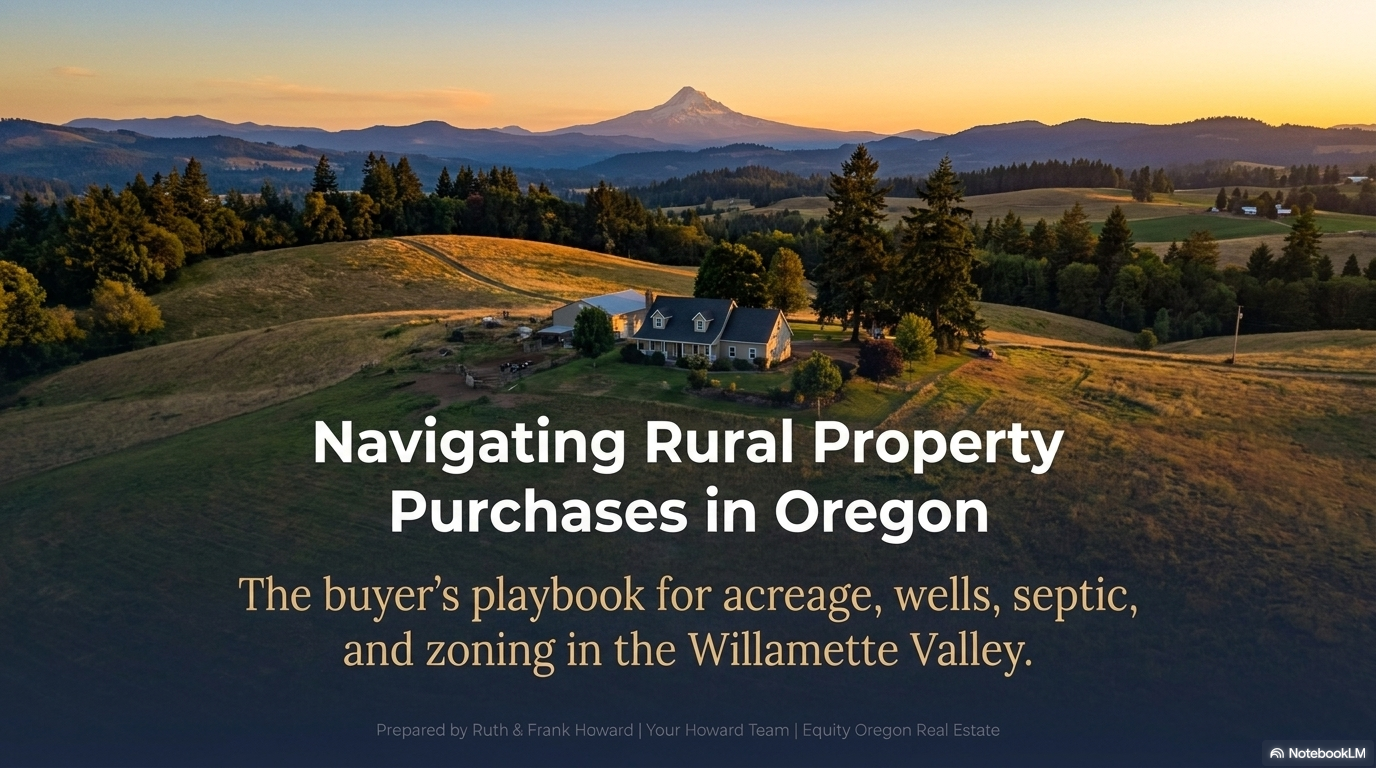
What to Know Before Buying a Rural Home in Oregon
Buying a rural home in Oregon comes with a checklist most buyers don't expect. Septic systems, well water testing, land use zoning, and rural-specific inspection items all factor into a transaction that looks nothing like purchasing a home in a neighborhood. Understanding what you're walking into before you make an offer protects your investment, your timeline, and your peace of mind.
There's a lot to love about rural property in the Willamette Valley — acreage, privacy, space for a shop or a garden, and the kind of quiet that's genuinely hard to find closer to town. Canby, Hubbard, Aurora, and the communities surrounding them offer exactly that, and we work with buyers in this geography regularly.
What we've found is that buyers who've only purchased suburban homes are often caught off guard by how different a rural transaction feels. The forms are different, the inspections are different, the pricing methodology is different, and the things that can derail a deal are different. None of it is insurmountable — but all of it rewards preparation.
This post covers what you need to know before you fall in love with a property and start writing an offer.
Rural Purchases Come With a Different Checklist
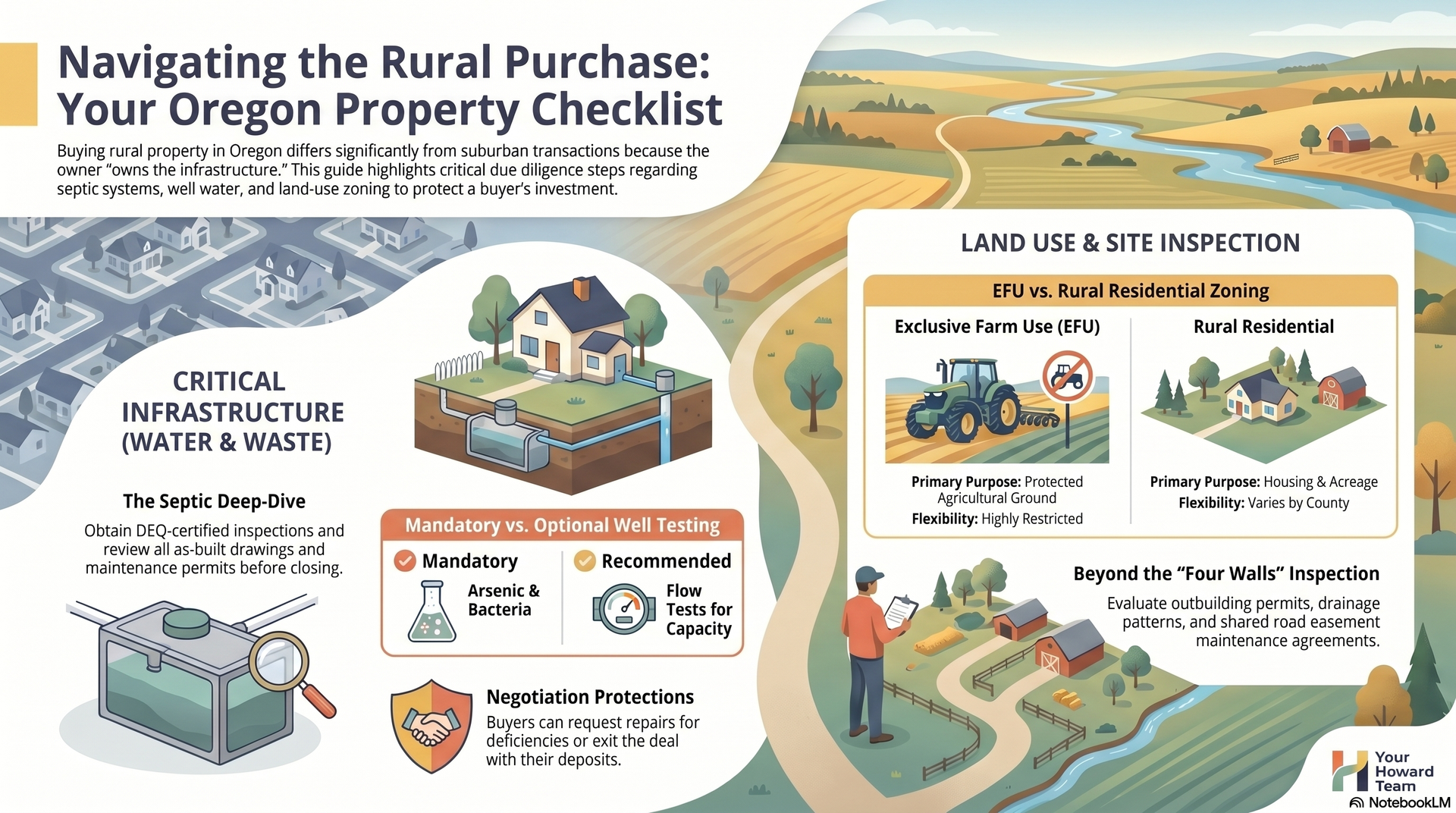
When you buy a home in a city or suburb, you're typically connecting to municipal water and sewer systems. The infrastructure is largely invisible and your exposure to it is minimal. On a rural property, you own the infrastructure. The well, the septic system, the pump, the pressure tank — these are yours to maintain, repair, and eventually replace.
That shift in responsibility is the foundation of everything else in this post. It's not a reason to avoid rural property — far from it. But it does mean your due diligence process needs to go deeper than a standard home inspection, and the agent you choose needs to understand what they're looking at.
Understanding the Septic System Before You Close
The septic system is one of the first things to investigate on any rural property. Oregon requires inspections to be performed by a DEQ-certified professional, and for good reason — a standard home inspector isn't qualified to evaluate an onsite sewage system, and replacement is costly.
As a buyer, you have the right to request all available system documentation from the seller — including as-built drawings, permits, maintenance records, and any recent inspection reports. Review these carefully. They'll tell you how old the system is, whether it was installed with a permit, what type of system it is, and whether it has a maintenance contract requirement.
If the inspection identifies a substantial deficiency, there's a formal negotiation process. You'll have the opportunity to submit a deficiency list and work toward an agreement on who bears responsibility for repairs. If no agreement is reached, you have the right to walk away and recover your deposits. Understanding this process before you're in it makes the negotiation far less stressful.
A few things worth knowing going in: there may be more than one onsite sewage system on a property, and some system components may not be physically located on the parcel they service. Oregon DEQ can also require decommissioning of any abandoned systems on the land. Ask about all of it before you're under contract.
Well Water — What Buyers Need to Know and Test
Oregon law requires sellers to test any domestic well for arsenic, nitrates, and total coliform bacteria before closing, at the seller's expense. Those results will be provided to you and submitted to the Oregon Health Authority. That's the baseline — but as a buyer, your testing rights go further.
You can order your own independent testing during the inspection period, including a well flow test to evaluate how much water the well produces under demand, as well as testing for lead or other water quality concerns beyond what the seller's required testing covers. Flow testing in particular is worth doing — a well that passes water quality testing can still have capacity limitations that matter significantly depending on household size or intended land use.
If your testing or the seller's testing identifies substantial deficiencies, the same negotiation process applies as on the septic side. You'll have an opportunity to work toward a resolution, and if none is reached, the right to exit the transaction.
One additional item to verify: whether the well is currently registered in Oregon's Well Identification Program. If it isn't, the seller is required to assist with registration at or following closing. You can check registration status through the Oregon Water Resources Department before making an offer — it's a small step that can surface issues worth knowing about early. For more detail on what sellers are required to do on the well side of a rural transaction, our companion post on what to know before selling a rural home in Oregon covers the full seller obligation picture.
How to Evaluate Acreage, Zoning, and Land Use
Zoning is one of the most important — and most overlooked — factors in a rural purchase. In Oregon, rural land often carries one of two primary designations: Exclusive Farm Use (EFU) or rural residential. The difference matters more than most buyers realize.
EFU-zoned land is protected agricultural ground. Oregon's land use laws are among the most protective in the country, and EFU designation comes with meaningful restrictions on what you can build, what activities are permitted, and what approvals are required. If you're buying EFU land expecting to subdivide, build additional structures, or operate a non-farm business, you need to verify what's actually allowed before you close — not after.
Rural residential zoning is generally more flexible, but it still carries restrictions that vary by county. Setback requirements, accessory dwelling rules, and permitted uses can all differ between Clackamas and Marion County, and between individual parcels within the same county.
Ask your agent to pull the zoning designation and contact the county planning department with specific use questions before you finalize your offer. It's a step that takes a phone call and can save significant frustration.
What to Look for in a Rural Home Inspection
A standard home inspection covers the structure, roof, electrical, plumbing, and HVAC. On a rural property, that's the starting point — not the finish line.
Beyond the standard inspection, you'll want attention paid to the well pump and pressure tank, both of which have finite lifespans and replacement costs worth factoring into your purchase decision. Outbuildings — shops, barns, equipment storage — should be evaluated for structural integrity, electrical condition, and whether any permits exist for their construction. Unpermitted outbuildings can create complications at closing or with your lender.
Drainage and grading matter more on acreage than they do in a subdivision, particularly in the Willamette Valley where wet winters are a reality. Look at how water moves across the property during rain events and whether there are areas of standing water or erosion concern near the home, well, or drain field.
If the property has a private road or shared easement access, understand who maintains it and what that obligation looks like. Rural access arrangements that seem simple can become complicated quickly when deferred maintenance or neighbor disagreements enter the picture.
Working With the Right Agent for a Rural Purchase
The right agent for a rural purchase isn't necessarily the one with the most sales or the biggest marketing budget. It's the one who has done this before in this geography and can guide you through the parts of the process that don't come up in a standard transaction.
The questions worth asking before you commit: Have you represented buyers on rural properties with septic and well water in this county? Do you understand Oregon's land use zoning designations and how they affect buyer due diligence? Do you have relationships with DEQ-certified septic inspectors, well drillers, and rural contractors? How do you approach pricing and offer strategy on acreage properties?
Agents who work rural transactions regularly will answer these questions specifically. Those who don't will be vague — and that vagueness tends to show up at the wrong moments. We work with rural buyers across the Willamette Valley — from Canby and Oregon City to Salem, Keizer, Woodburn, Hubbard, Aurora, and surrounding areas — and we understand what the process involves from the first showing to the closing table.
Frequently Asked Questions
Can I waive the well water inspection when buying a rural home in Oregon?
The seller's required testing under Oregon law cannot be waived — that happens regardless of your preference. However, your own additional testing, such as a flow test or expanded quality panel, is optional. Waiving it is a risk worth weighing carefully. A well that passes the required quality tests can still have flow capacity issues that matter significantly for your household.
What should I know about buying a home with a septic system?
The most important things: get a DEQ-certified inspection, review all available system documentation, understand the age and type of system, and know your negotiation rights if a deficiency is found. Septic system replacement is costly — the inspection fee is a fraction of that and the information it gives you is worth far more.
What happens if the septic or well fails inspection?
You don't automatically lose the deal. Oregon transactions include a formal negotiation period where both parties work out responsibility for identified deficiencies. If an agreement is reached, the transaction moves forward on those agreed terms. If no agreement is reached, you have the right to walk away and recover your deposits. It's one of the more important protections a buyer has in a rural transaction.
How does EFU zoning affect what I can do with rural land in Oregon?
EFU designation means the land is protected for agricultural use under Oregon's land use planning laws. Permitted uses, building rights, and allowable activities are more restricted than on rural residential land. What's allowed varies by county and by specific parcel. Before purchasing EFU land with specific plans for its use, verify those plans directly with the county planning department. Your agent should be able to help you get the right questions in front of the right people before you're committed.
Buying rural property in Oregon is a rewarding process when you know what to expect going in. Reach out for a local snapshot — no pressure, just real insights. We help buyers navigate rural purchases across the Willamette Valley and understand what it takes to find the right property and close with confidence.
Ruth & Frank Howard, Brokers | Your Howard Team | Equity Oregon Real Estate | yourhowardteam.com
 All information provided is deemed reliable but is not guaranteed and should be independently verified. IDX information is provided exclusively for consumers' personal, non-commercial use, that it may not be used for any purpose other than to identify prospective properties consumers may be interested in purchasing, and that the data is deemed reliable but is not guaranteed accurate by RMLSTM.
The content relating to real estate for sale on this web site comes in part from the IDX program of the RMLSTM of Portland, Oregon. Real estate listings held by brokerage firms other than Equity Oregon Real Estate are marked with the RMLSTM logo, and detailed information about these properties includes the names of the listing brokers. Listing content is copyright © 2026 RMLSTM, Portland, Oregon.
This content last updated on September 21, 2026 1:28 PM UTC at 4 AM. Some properties which appear for sale on this web site may subsequently have sold or may no longer be available.
All information provided is deemed reliable but is not guaranteed and should be independently verified. IDX information is provided exclusively for consumers' personal, non-commercial use, that it may not be used for any purpose other than to identify prospective properties consumers may be interested in purchasing, and that the data is deemed reliable but is not guaranteed accurate by RMLSTM.
The content relating to real estate for sale on this web site comes in part from the IDX program of the RMLSTM of Portland, Oregon. Real estate listings held by brokerage firms other than Equity Oregon Real Estate are marked with the RMLSTM logo, and detailed information about these properties includes the names of the listing brokers. Listing content is copyright © 2026 RMLSTM, Portland, Oregon.
This content last updated on September 21, 2026 1:28 PM UTC at 4 AM. Some properties which appear for sale on this web site may subsequently have sold or may no longer be available.
